
India's privatisation push, once projected as a cornerstone of economic reform, has suffered another setback, with the Centre set to call off the IDBI Bank stake sale, highlighting the political and structural constraints shaping the country's disinvestment policy, experts say.

Unified Payments Interface (UPI) transaction value and volume saw a slight month-on-month dip in April after record highs in March, but daily transaction volumes increased, indicating sustained growth in digital payments across India.

The BJP-led government in Bihar secured a vote of confidence in the state assembly, with Chief Minister Samrat Choudhary pledging economic development and significant investments. The motion was passed amidst heated debates and accusations between the ruling NDA and the opposition, highlighting political tensions and differing views on issues like women's reservation.

'It is a tradeoff between convenience and fraud prevention.'

Moody's Ratings has reduced India's GDP growth forecast for 2026 to 6 per cent, citing subdued private consumption, capital formation, and industrial activity due to higher energy costs and global uncertainties.

BJD president Naveen Patnaik has requested Union Finance Minister Nirmala Sitharaman's intervention in a case where an Odisha tribal man was forced to exhume his sister's skeleton to prove her death to a rural bank. Patnaik seeks accountability for the incident, which has sparked public outrage.
Two-factor authentication for all digital transactions, including UPI, is now mandatory in India, as per RBI guidelines, to enhance security and curb fraud.

This is the time for India to plan forward fully, with the goal of Atmanirbharata, and energy security. The Persian Gulf is no longer a reliable source, points out Rajeev Srinivasan.

Maharashtra's Governor and Chief Minister, along with other state leaders, paid tribute to Dr. B.R. Ambedkar on his 135th birth anniversary, recognising his profound impact on social justice, equality, and the Indian Constitution.

'At the first sign of real trouble, that money will move. There will be a run.'

'In India's case, an extended earnings slowdown accompanied by rich valuations have dimmed returns since late 2024.'

The CBI has filed a chargesheet against a man accused of defrauding a retired banker of Rs 23 crore in a sophisticated digital arrest scam involving impersonation of law enforcement and judicial authorities.

S&P Global Ratings warns that a sustained rise in crude oil prices to $130 per barrel could significantly slow India's economic growth, weaken fiscal metrics, and strain corporate and banking sector performance, potentially reducing growth by up to 80 basis points.

IRCTC is expanding its payments arm, IRCTC Payments, to handle transactions across its ticketing platform and tap government clients, aiming to scale its annual payment processing to approximately 1 trillion.
The proposed solution is a one-hour delay for digital transactions exceeding Rs 10,000, particularly when the transfer is made to a new or unverified beneficiary. The idea is simple -- give users a window to reconsider, detect fraud or alert their bank before the funds are irretrievably transferred.

Even if there is an early agreement on a cessation of hostilities in West Asia, the price shock will not go away easily, points out A K Bhattacharya.
Uncertainties stemming from the West Asia crisis and its potential impact on inflation and economic growth were key factors in the Reserve Bank of India's Monetary Policy Committee (MPC) decision to maintain the status quo on interest rates, according to the recently released MPC meeting minutes.

Airpay Payment Services has partnered with Maharashtra State Co-operative Bank (MSCB) to enable UPI-based digital payments across the lender's network in Maharashtra, aiming to accelerate financial inclusion in rural areas.
Unified Payments Interface (UPI) transactions in India reached a record high in March, driven by increased adoption and global expansion. The system now accounts for 85% of digital transactions in India and is live in eight countries.
Unified Payments Interface (UPI) transactions in India reached a record high in March, with 22.64 billion transactions, marking a significant increase from the previous year and highlighting the growing adoption of digital payments.

"It is quite possible that the rates will remain low in the near to medium term, but that will depend on how conditions evolve," said RBI Governor Sanjay Malhotra.

Petroleum Sports Promotion Board (PSPB) and Reserve Bank of India (RBI) will compete in the final of the 87th UTT Senior National Table Tennis Championships after defeating Uttar Pradesh and Karnataka respectively.
The government on Friday received financial bids for the strategic disinvestment of IDBI Bank, the Department of Investment and Public Asset Management (Dipam) said in an official statement on X.

The Reserve Bank of India (RBI) announced that it processed 99.8% of applications within the prescribed timeline under its Citizen's Charter in February, demonstrating high efficiency in its operations.

Only bona fide victims would be compensated by banks within five days of receiving the complaint.

The Reserve Bank's gold reserves crossed 880 metric tonnes in the first half of 2025-26 with the central bank adding 0.2 metric tonnes in the last week of September. The total value of the gold was $95 billion as of September 26, 2025, according to the latest data from the Reserve Bank of India (RBI).

'We are staying away from making forward-looking statements on when we will reach 1 trillion, etc. But growth will be rapid; it's only a matter of time.'

If Tata Sons is listed, the special veto rights of Tata Trusts, under Article 121A, may have to go away.

From April 1, 2026, the Reserve Bank of India's new authentication directions modernise how every digital payment you make must be verified -- and place the burden of security squarely on your bank, not on you.

Pakistan's skewed foreign reserves got a major boost after Saudi Arabia pledged an additional $3 billion in deposits while extending its existing $5 billion facility for a further three years.

'Whether you will bring this down and cause hurt to senior citizens, who are probably living on that little interest rate that they earn out of it... But equally, if I just look at the kitty of the National Small Savings Fund, it is from that same kitty that I'm borrowing.'

The rupee plunged to a fresh low of 93.72 against the dollar on Friday, falling 1.15 per cent in a single session - its sharpest one-day decline since February 24, 2022 - as elevated crude oil prices and strong dollar demand from oil-marketing companies and foreign portfolio investors (FPIs) weighed on the currency.
Banks are depending more heavily on the market for certificates of deposit (CDs), whose worth climbed to a record Rs 5.75 trillion in the fortnight to January 15, owing to deposit tightness in the system.

India's forex reserves jumped by $8 billion to an all-time high of $709 billion during the week ended January 23, the RBI said on Friday.

The Reserve Bank on Tuesday proposed greater flexibility to authorised persons to undertake foreign exchange transactions for hedging their exposures, balance sheet management and market-making, as well as to ease reporting obligations, after a review of the current regulations.

India's wholesale price inflation surged to 3.88 per cent in March, marking the fifth consecutive monthly increase, primarily driven by a sharp rise in crude petroleum, natural gas, and manufactured items amidst the West Asia crisis.

India's forex reserves dropped $5.62 billion to $689.73 billion for the week ended October 31, the Reserve Bank of India said on Friday. The overall reserves had declined by $6.92 billion to $695.35 billion.
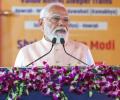
Prime Minister Narendra Modi criticised the ruling TMC in West Bengal, alleging corruption and appeasement politics, while promoting the BJP's development agenda ahead of the assembly elections.

In a move aimed at curbing the mis-selling of financial products, the Reserve Bank of India (RBI) has proposed banning incentives paid to bank staffers by third parties such as insurance companies and mutual fund houses for selling their products and services. It has also proposed that banks must ensure their user interfaces do not deploy "dark patterns" to lure customers.

The Indian economy is growing at a robust pace, driven by strong domestic demand, low inflation, and the healthy balance sheets of banks, said a Reserve Bank report released on Wednesday.
 © 2026 Rediff.com - Advertise with us - Disclaimer - Privacy Policy - Sitemap - Feedback - About us - Terms of use - Grievances